PepsiCo
Or Frito-LayCo?
I can summarize my narrative of PepsiCo (“Company”) in three points (more details in the post below):
As the number one company in Snacks globally, the Company has been riding on the tailwind of a global trend in increased snacking. Consumers are moving towards more unstructured meals throughout the day with smaller bite sizes. Millennials are also snacking more as compared to adults
Underperforming Beverages business (over last few years) looks set to inflect positively in the short to medium term, as Management re-focuses on the business with increased investments
Moat should widen in the near term as its aggressive capital expenditure program over the last few years should start to bear fruit. Moreover, the Company should come out of the COVID-19 crisis stronger due to its pristine balance sheet (optionality), Direct Store Delivery system (control), and ownership of its bottlers (control)
What is PepsiCo?
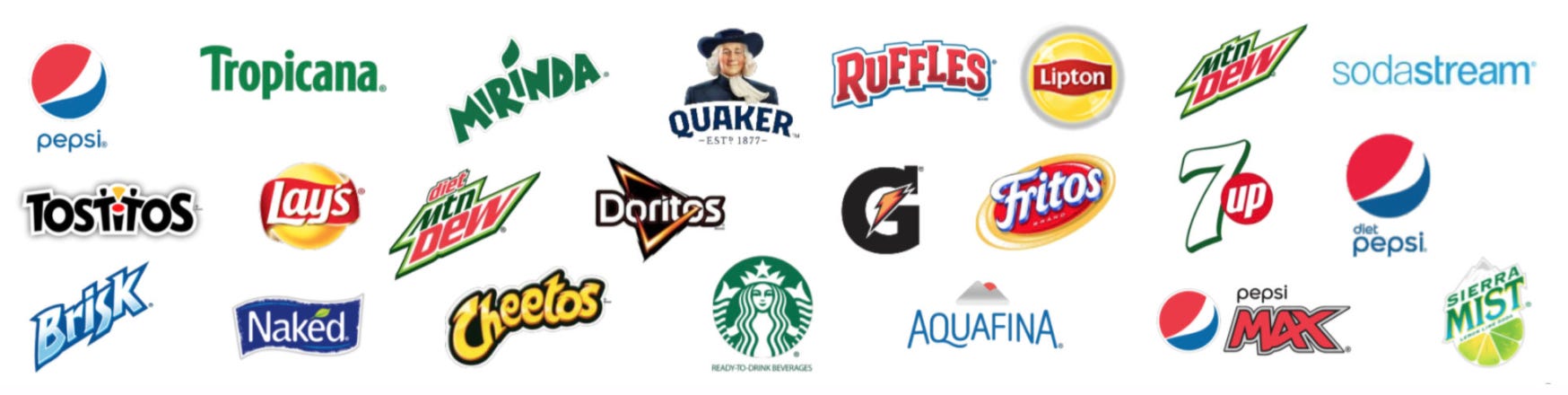
PepsiCo is a leading global food and beverage company with 23 billion dollar brands such as Lay’s, Pepsi, Ruffles, Gatorade, Tropicana, Quaker’s.
The company has six operating divisions: Frito-Lay’s North America (“FLNA”), Pepsi Beverages North America (“PBNA”), Quaker Foods North America (“QFNA), Europe, Latin America (“LatAm”), Africa, Middle East, South Asia (“AMESA”) and Asia Pacific, Australia and New Zealand, and China (“APAC”). 71% of its revenues are from Developed Markets, and 29% are from Developing Markets, with US being its key market at 58% of net revenues.
Beverages only contribute 45% to PepsiCo’s net revenue and an even smaller 25% to its operating profit. The bulk of the company’s revenues and profits is derived from Snacks.
Global leader in Snacks - FLNA as the crown jewel

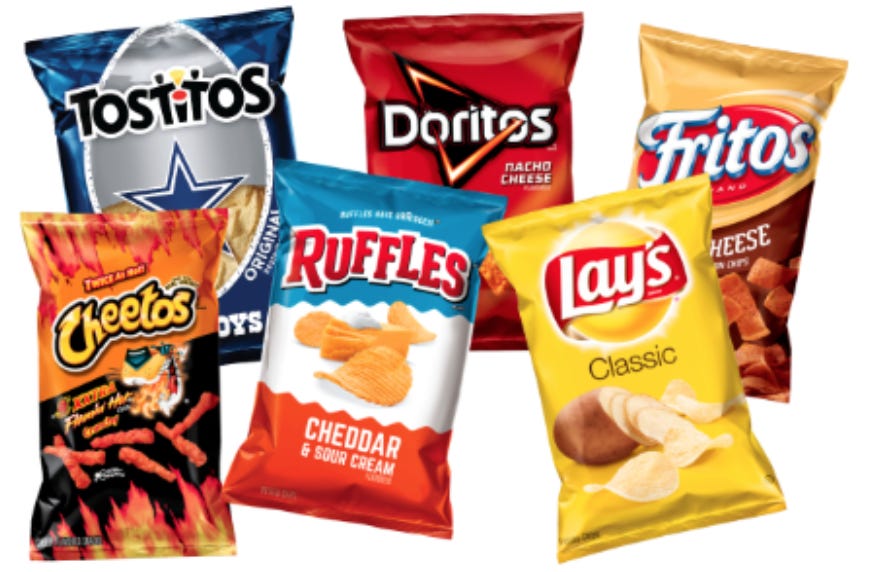
The Snacking business has been one of the few growing markets in the Consumer Packaged Goods (“CPG”) space, driven by the trend of consumers moving towards more unstructured meals throughout the day, providing convenience and smaller bite sizes.
Despite its leading position and large base, the business is still growing steadily. FLNA delivered 4.5% organic revenue growth in 2019 and has been taking market share in US Salty Snacks over the last few years (~60% market share). FLNA drove nearly half of the Company’s net revenue growth from 2015-2019, and ~80% of Earnings Before Interest and Tax (“EBIT”) growth in the same time period. Near term growth opportunities in FLNA includes smaller and premium packaging, and also expanding into adjacencies in the broader Snacks business. FLNA should continue to grow in the low to mid-single digits in the near to medium term on the back of category growth and steady market share
In Emerging Markets (“EM”), most of the growth has been driven by Snacks as well. The EM business is surprisingly (at least to me) profitable, with Operating Profit Margins (“OPM”) in LatAm, APAC, AMESA above 15%, higher than its PBNA businesses. With the emergence of the middle class and more disposable income, consumers are snacking more. However, one thing to note is that Coco-Cola has a significant share advantage in Carbonated Soft Drinks (“CSD”) in many of the Emerging Markets, and it seems unlikely for PepsiCo to reverse that in the short term.
Turnaround story in its underperforming Beverages business to drive inflection in margins
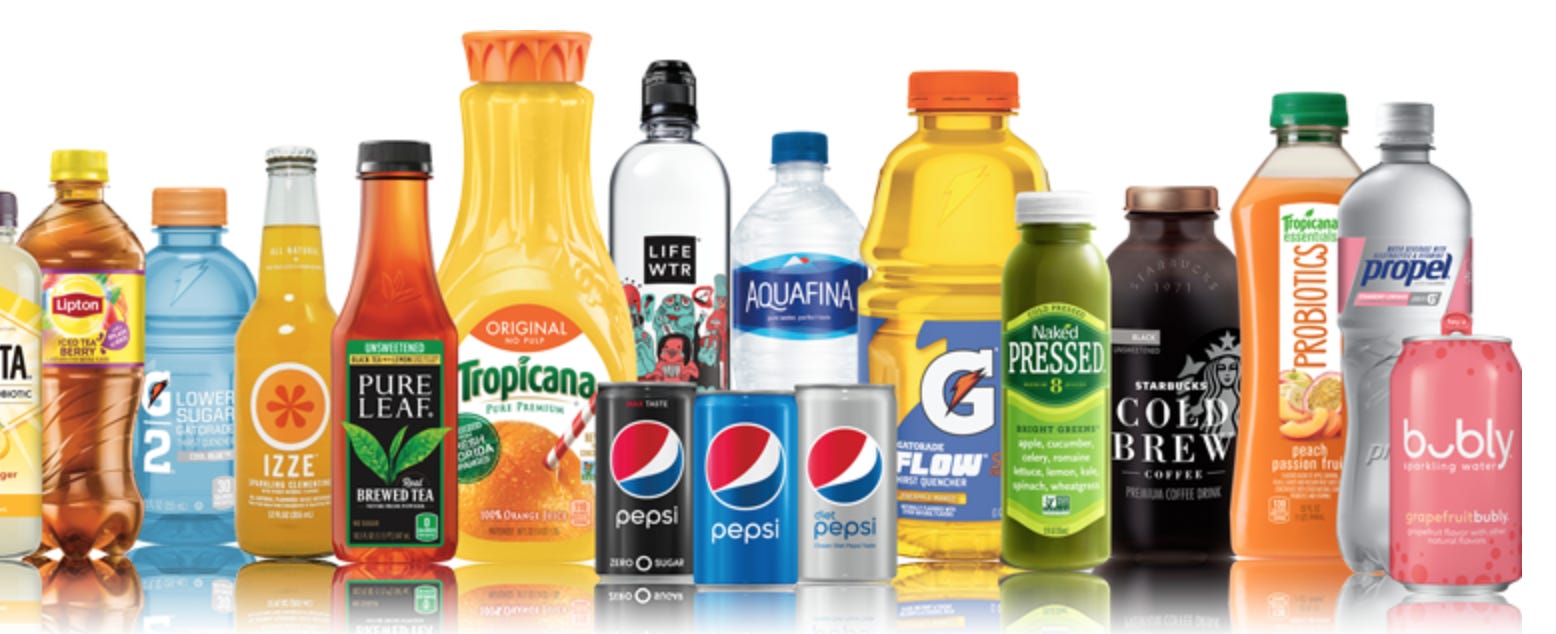
The Company has not been doing well in Beverages, but recent focus, innovation and investments should reinvigorate growth for the long term. PBNA is the company’s largest segment in terms of revenue, but the least profitable division, generating one-third of sales and only one-fifth of operating profits. The segment has been losing market share, experiencing negative top-line growth, and operating deleverage (OPM decreasing as the lower sales are spread over a relatively stable fixed cost base).
However, the Company has re-focused on this business for the last couple of years, investing in advertising and marketing, go-to-market routes, manufacturing capacity etc.. In addition, innovation over the last few years have been strong as well, as the Company built the bubly brand and Gatorade Zero successfully (both likely to become billion-dollar brands soon)
Another important strategic direction has been to move into Energy Drinks business in a big way – albeit slower than its competitors. The recent acquisition of Rockstar Beverages enabled the company to expand further into this space. Before the acquisition, the previous distribution agreement with Rockstar prohibited PepsiCo to participate in the Energy Drinks Business other than distributing Rockstar Beverages. Following the acquisition, the Company also announced a distribution agreement with Bang, and at the same time declared intention to pivot Mountain Dew into the Energy space. A successful venture into this space should help both volume and price/mix of its top line, as the Energy Drink space in the US is still growing mid-high single digits, and OPMs are typically higher as well
As a result, there is potential for an inflection in growth and margins in this business, which should drive profitability in the longer term. On the 1Q2020 earnings call transcript, CEO Ramon Luis Laguarta commented:
At PepsiCo Beverages North America, our carbonated soft drink business performed well, with trademark Pepsi increasing its net revenue for the 7th consecutive quarter, while trademark Mountain Dew returned to growth.
Even though this streak was broken by COVID-19 as organic revenue declined 7% in 2Q2020 (mainly driven by declines in the convenience and gas and food service channels), the momentum in the business has been strong in over the previous few quarters.
Moreover, OPM was at 10% pre-COVID (2019A), which is very low compared to both its history and to peers. The segment’s OPM is not really comparable to Coca Cola (OPM at 20+%), as Coca Cola does not own its bottlers (lower margin business) unlike Pepsi. That said, 10% OPM seems exceptionally low, even lower than PepsiCo’s domestic bottlers when they were still publicly traded. My guess is that the OPM for this business should start to trend higher post-COVID. A growing topline would help to provide some operating leverage as well.
Widening moat
Both its Snacks and Beverages businesses have billion-dollar brands that have helped the Company establish it’s moat. Its extensive distribution network (as a sidenote, PepsiCo helps to distribute several brands that it doesn’t own, such as Ready-to-Drink Starbucks, Lipton Tea, and now Bang) is also a key competitive advantage. Furthermore, with the Company’s significant investments over the last couple of years into advertising, route-to-market, supply chain, manufacturing capacity, pivot towards Energy Drinks, we are starting to see the investments bear fruit as the already wide moat continues to grow.
The Company should come out of the COVID-19 crisis stronger relative to its peers, due to its solid balance sheet that provides options to further invest into the crisis and take share from its smaller competitors, or potentially buy up smaller companies that are facing cash flow issues on the cheap. Last but not least, its Direct Store Delivery system and ownership of its beverages bottling operations should give the company more control and visibility with the current COVID-19 supply chain disruptions, albeit at a higher cost. To be clear, I do not like the Direct Store Delivery system and ownership of the bottlers in the long term, but in the short term, this should benefit the Company.
Valuation and numbers
There are around 1,387MM shares outstanding. With a share price of $138, market capitalisation works out to $191.4bn. Adding on net debt of $35bn gives an Enterprise Value (“EV”) of $226.4bn. Company had sales of $67.2bn in 2019, and EBIT of $10.6bn, EV/2019 Sales is at 3.4x and EV/2019 EBIT at 21.3x. PepsiCo does not have a clean comparison due to the mix of its business (snacks and beverages), but I’ve provided Nestle as a reference. After adjusting its EV for its stake in L’Oreal (significant stake of around EUR35bn), Nestle is trading at EV/2019 Sales of 3.4x, and EV/2019 EBIT of 19x.
PepsiCo’s valuation is currently at the higher side of its historical trading range, but taking into consideration the low interest rate environment and the stability of its future cash flows (the company performed admirably even with the current COVID-19 crisis), the discount rate would be lower as well, which supports a higher present value as future cash flows into perpetuity are discounted at a lower rate
In terms of shareholders return, PepsiCo has reiterated its guidance for 2020 despite COVID-19, with $5.5bn in dividends and $2bn in share buybacks, which gives a shareholder yield of around 4%. The Company’s Free Cash Flow (“FCF”) is currently unable to support that return due to elevated levels of capital expenditure (cap-ex) and investments during these few years. However, I am not particularly concerned as I estimate that the maintenance cap-ex for the Company is much lower, and that after the Company exits its current investment phase, FCF will be able to support increasing shareholders’ returns. At the moment, the capital returns are partially funded by increased debt - the Company has been opportunistically issuing long term debt at very low levels.
Return on Invested Capital has been stable at around the 20% levels, and the trend of this metric is something I closely monitor, as it speaks to the trajectory of the Company’s moat and competitive advantages.
What are the risks?
As snacks is a very attractive sub-segment in the CPG industry, we have seen other CPG companies increasing their investments in this area, which should lead to increasing competitive pressure. However, Pepsico has demonstrated its ability to grow and continue to take market share in its snacks business for the last few years even in this increasingly competitive space
House brands and the advent of e-commerce has been plaguing the Consumer Staples Industry as a whole. PepsiCo has been trying to invest into its e-commerce and omnichannel capabilities, but this is definitely a risk worth monitoring
Company needs to adapt to healthier lifestyle choices, especially in its core Developed Markets, as consumers stay away from sugary drinks such as CSD. Also, governments such as the UK, have enacted “sugar taxes”, which might impact price/mix and volume
Not risk per se, but I have a question for everybody: Why can’t I find details of PepsiCo’s 20% equity stake in Calbee in its 10K? It should be classified as equity method investee, but I cannot seem to find information on that anywhere in the 10K. I only see a line on the balance sheet “Investments in Noncontrolled Affiliates”, but no additional details… Thank you in advance.
What do I think?
PepsiCo is a high-quality compounder with strong brands aided by a longer-term trend of increasing snacking. Snacks business should continue to do well despite increasing competition, and Beverages business seems poised for a turnaround with increased investments and focus, and innovation over the last few years. Valuation based on current earnings is not cheap as compared to its history and also to its large-cap peers due to its current heavy investments phase leading to depressed near term earnings.
In the medium term post-COVID, with 4-5% organic revenue growth, expansion of OPM on the back of recent investments, consistent share buybacks and 2% dividend, and the low-for-long interest rate environment supporting valuation, I believe total shareholder’s return will likely be in the high-single digits level annualized over the medium term.
Based on current valuation and my expectations of future cash flows, this is a stock that is unlikely to make you very wealthy overnight, but very likely to compound wealth for you over the long term with more certainty and less volatility than the overall index. Amidst one of the worst global crises in the last 50 years, the Company is not only honoring its dividends (many companies have either reduced or canceled their dividends), but it is also committing to continue to buy back shares to return capital to shareholders.
What’s next?
I will likely continue with another couple of posts on Coca Cola and Keurig Dr Pepper to round up three of the main North America Non-Alcoholic Beverages, and probably a summary post as well. Keep a lookout for that!
Please share this post with your friends if you believe they will like it, thank you!
Disclaimer: The content here is for informational purposes only and should NOT be taken as legal, business, tax, or investment advice. It does NOT constitute an offer or solicitation to purchase any investment or a recommendation to buy or sell a security.